Presently the rain has stranded me in my house, but not before a forty-minute walk home in moderate drizzle. Luckily I had the foresight to both close my kitchen window (so as to avoid a repeat flood) and to bring my rain jacket. It began to rain when I was at hospital vaccinations cringing at the most ear-piercing of infant screams. During a brief period of reprieve, I ran over to the CEG/high school to ask if my campers had turned in their permission slips. Friday is the last day of school, and I really need to meet with them at least once before then. Somehow I am down to the absolute wire on this and at the point of near panic. So I really hope it stops raining so the girls will come back to school this afternoon. Deep breaths! I also have a village-wide baby weighing tomorrow in Pede, a little town about 5k north of Kandi and need to color in about sixty growth charts.. But because I also need to work on Peace Corps' Goal 3, I'd rather be writing.
So despite my crazy schedule of late, I've been counting down the days until July 2nd, which marks one year in Benin. In some ways it feels like I just arrived with a group of fifty-plus trainees, all anticipating becoming strangers (or yovos or batoures or anasaras!) in a strange land. And other times it seems I've been here my entire adult life. Perhaps I've lost perspective, but I do believe it to be a huge accomplishment and have decided to celebrate by a) baking brownies and b) buying myself some new clothes online to bring back when I go home on vacation.
Just as I had lately pondered how much my life has changed in the last year, I noticed Paul Farmer had been chosen by Foreign Policy magazine as one of the 100 Most Influential Global Leaders of 2011. Dr. Farmer is a medical anthropologist at Harvard and co-founder of Partners in Health, an absolutely fantastic organization (and my dream employer) whose focus is improving healthcare to the poor of Haiti, but also in a few other mostly forgotten locales like Peru, Russia, and Rwanda. Check them out at http://www.pih.org/. He believes (as you would think most people would, but apparently not) that the poor deserve preferential treatment in healthcare. He believes, too, that medical and social issues are intertwined. You can't solve one without addressing the other. I first read about Dr. Farmer's work in 2009 in Tracy Kidder's Mountains Beyond Mountains, and I can say without hesitation that it set me on a new course. This book, combined with cubicle-induced wanderlust, led me to Peace Corps Niger as a community development volunteer, then by the grace of God/Allah (though I didn't know it at the time), to Peace Corps Benin as a rural health volunteer. One trip to the library changed my life; my librarian friends would be proud! My close friends will also recall that I, by some strange and most excellent twist of fate, met Dr. Farmer (who sported a giraffe tie) on the way to Benin. On the escalator at the Brussels airport, in fact. He was surprised to be recognized and he thanked me and my fellow volunteer John for serving. One of the happiest moments of my life and feeling totally validated: check and check.
Actually, now that I think about it, that was the second strange and most excellent twist of fate of this journey: the first was passing the New York Times building on our way to JFK and eventually to Africa. NYT columnist Nick Kristof has taught me more about social issues (particularly involving women and children) through his column and the book he wrote with his wife, Sheryl WuDunn, Half the Sky, than any other public figure I can think of. His column (and frankly all of the New York Times) is on my top five things I miss from America . (It is accessible online, of course, but I feel like magic is slightly lost.) Anyway, thanks to Dr. Farmer, Nick Kristof, and eighteen months and counting in Africa, I'm a different person, and hopefully mostly for the better. Even through all the moments I miss my family to the point of near tears, the mosquito bites, the bouts of foodborne illness, and any given taxi ride, I know I made the right decision to come.
Friday, June 15, 2012

Wednesday, June 13, 2012
On clothing
Oh, Saturdays. My day to get up at the first cock-a-doodle-do and run around like a crazy person in the morning so that I can recline on my little wicker couch all afternoon watching Arrested Development and enjoying the luxury of a carbonated beverage. After a peaceful run around the market and down the main drag, I took on the task of laundry, especially important given that I'm traveling tomorrow. In the grand tradition of 'I should know this by now,' I left my clothes out on the line (though, granted, still under the eaves of my porch) and went to run some errands that included tracking down the guy who sells bus tickets for two different transport companies. (He was setting up for a concert at the "nightclub," La Maison Blanche. What a little entrepreneur!) The second it started clouding over, I knew I should just turn around and go home. Long story short, I have now put my fan to use as my dryer. We'll see just how long it takes. My neighbors, who I alternately love and hate depending on their noise level, had gathered up all my clothes and put them inside their house. Cloud and silver lining.
I would estimate that I wear something that looks vaguely Beninese/West African about half the time. This percentage increases as my American clothes are getting dingier and not really wearable. I'm sure I'm still sporting things that most people - including myself in my normal life - would have thrown out months ago. I have legitimate worries about what I'm going to wear on the plane in October when I go home on vacation. As of now I'm planning to have something VERY African made because otherwise I'm pretty sure I might be mistaken for a homeless person. and also because I no longer have any qualms about people staring at me. Looking sharp is important here. Wearing anything with holes or visible dirt is a no-no, as it's seen as a lack of respect. I'm sure I get a little more leeway, being a "batoure" and all. Anyway, here is a primer on Beninese fashion:
The majority of normal village people wear "tissue," which is (usually) very brightly colored, patterned fabric. In two-meter form, as they are sold, they are known as "pagnes." Every mother uses old pagnes to carry babies on their backs. (I will demonstrate with a sack of flour the next time I see you.) So for very budget-conscious women, this simple two meters of fabric turns becomes a wrap skirt. No tailor required. (Affixed as though you were wearing a bath towel.) This is most likely paired with some sort of tee-shirt. Some women will have a very simple hem put on the skirt and also add ties to make the wrapped nature of the skirt a little more secure. My host family in Porto-Novo had one made for me, and though some volunteers love them, I wore it all of twice because I lived in perpetual fear that it would fall open. And you have to walk like a geisha. With a nicer, tied skirt, women will wear a very simple shirt (3/4 length sleeves) made of the same fabric. They're usually very roomy and are tucked into the skirt. (So for someone who doesn't like tucking things in, this is obviously not a look I go for, although I was told I looked cute the one time I tried it.)
For women of greater means, fancier blouses and fitted, more tailored skirts are the norm. I see a lot of elastic, accordian (?) -like shirts here in Kandi. There are a lot of puffed sleeves (Anne Shirley would have been in heaven) and, it's pretty popular to have your shirt bejeweled. (Let's pretend that's an actual word.) There are a lot of stick-on rhinestones and stars and stuff on women's clothing. I find the extensive embroidery to be a much classier look.
Men in Kandi actually wear a lot more Western-type clothing than I would have expected, especially the young men. Maybe it's an influence from Nigeria, I'm not sure. The traditional man's outfit is called a boomba. Think of men's pajamas in crazy fabric prints. There's not a whole lot of variation with the boomba, but there are a lot of variations in fabric quality. So the wealthier men still have a way to stand out. I myself got a boomba made, and no one really thought it was weird. Very, very occasionally you'll see a woman wearing a boomba with pants.
I am lucky in that no one really makes comments on my choice of clothes. I can wear pants and jeans without worry, which is more than some female volunteers can say. Though most of my tissue outfits don't follow the exact Beninese style (at all), most people seem to be happy that I'm at least trying. In Kandi, I do have to be careful about showing my knees and shoulders. Some of my dresses are about mid-calf length and even then you'd be surprised at how many people stare at my calves. Maybe they're confounded (as I am) as to the contrast in skin tone compared to my arms and face. Shocking indeed! Until next time, bonne sante!
 |
| Laundry day chez moi! |
The majority of normal village people wear "tissue," which is (usually) very brightly colored, patterned fabric. In two-meter form, as they are sold, they are known as "pagnes." Every mother uses old pagnes to carry babies on their backs. (I will demonstrate with a sack of flour the next time I see you.) So for very budget-conscious women, this simple two meters of fabric turns becomes a wrap skirt. No tailor required. (Affixed as though you were wearing a bath towel.) This is most likely paired with some sort of tee-shirt. Some women will have a very simple hem put on the skirt and also add ties to make the wrapped nature of the skirt a little more secure. My host family in Porto-Novo had one made for me, and though some volunteers love them, I wore it all of twice because I lived in perpetual fear that it would fall open. And you have to walk like a geisha. With a nicer, tied skirt, women will wear a very simple shirt (3/4 length sleeves) made of the same fabric. They're usually very roomy and are tucked into the skirt. (So for someone who doesn't like tucking things in, this is obviously not a look I go for, although I was told I looked cute the one time I tried it.)
 |
| My fellow volunteers modeling Beninese styles |
For women of greater means, fancier blouses and fitted, more tailored skirts are the norm. I see a lot of elastic, accordian (?) -like shirts here in Kandi. There are a lot of puffed sleeves (Anne Shirley would have been in heaven) and, it's pretty popular to have your shirt bejeweled. (Let's pretend that's an actual word.) There are a lot of stick-on rhinestones and stars and stuff on women's clothing. I find the extensive embroidery to be a much classier look.
Men in Kandi actually wear a lot more Western-type clothing than I would have expected, especially the young men. Maybe it's an influence from Nigeria, I'm not sure. The traditional man's outfit is called a boomba. Think of men's pajamas in crazy fabric prints. There's not a whole lot of variation with the boomba, but there are a lot of variations in fabric quality. So the wealthier men still have a way to stand out. I myself got a boomba made, and no one really thought it was weird. Very, very occasionally you'll see a woman wearing a boomba with pants.
I am lucky in that no one really makes comments on my choice of clothes. I can wear pants and jeans without worry, which is more than some female volunteers can say. Though most of my tissue outfits don't follow the exact Beninese style (at all), most people seem to be happy that I'm at least trying. In Kandi, I do have to be careful about showing my knees and shoulders. Some of my dresses are about mid-calf length and even then you'd be surprised at how many people stare at my calves. Maybe they're confounded (as I am) as to the contrast in skin tone compared to my arms and face. Shocking indeed! Until next time, bonne sante!
Thursday, May 31, 2012
Yesterday marked the first time this rainy season that it rained in the daytime. Prior to this, skies would cloud over, unbeknownst to us down below, lightning would fire up, and the winds would start howling, making you wonder if you were magically transported back to Kansas in time for a spring tornado. I enjoy these nighttime deluges because they do not inconvenience me in the least, except when I realize I need to go to the bathroom. Normally these storms would wrap up nicely by 2 or 3 am, allowing at least a little bit of peaceful dormir-ing.
Now, though, the rains start on up whenever they feel like it, which poses a problem with regards to actually getting things done. As in, anything that requires leaving the house.

I may have alluded to this earlier, but Kandi - my post of 20,000 people - has exactly two paved roads, one of which is the highway. So you may imagine what terre rouge (dirt roads) turns into after a heavy downpour. A giant, caramel-colored mess. Sometimes there's just no way to avoid the puddles; plodding right through them is the only option. But then there's the fear of contracting schistosomiasis from standing water. Gah! I'm learning which spots on the path to my health center and to the social services center gather the most water. I almost feel like I'm an urban planner doing research. Really, I just wish they'd pave the damn roads.
Which reminds me....things I can change vs. things I should just accept already. This week telling the difference has been a bit of a struggle. Here are some examples:
A toute a l'heure!
Now, though, the rains start on up whenever they feel like it, which poses a problem with regards to actually getting things done. As in, anything that requires leaving the house.

The concession after a rainfall.
I may have alluded to this earlier, but Kandi - my post of 20,000 people - has exactly two paved roads, one of which is the highway. So you may imagine what terre rouge (dirt roads) turns into after a heavy downpour. A giant, caramel-colored mess. Sometimes there's just no way to avoid the puddles; plodding right through them is the only option. But then there's the fear of contracting schistosomiasis from standing water. Gah! I'm learning which spots on the path to my health center and to the social services center gather the most water. I almost feel like I'm an urban planner doing research. Really, I just wish they'd pave the damn roads.
Which reminds me....things I can change vs. things I should just accept already. This week telling the difference has been a bit of a struggle. Here are some examples:
- Igor, the three year-old who lives in my concession, cannot be silenced. He will continue to scream and act like a needy brat no matter how often I swear at him under my breath (and out of earshot). Upside: he is not my child.
- The rains will continue making walking paths non-existent. Plus side: rain = crops = happy Beninese people. Also, it is no longer 115 degrees. Dieu merci. Seriously.
- There are never not going to be 75+ women and screaming kids each day at vaccinations. There's no slow season for births in Benin, apparently. Plus side: filling out health cards and weighing all those kids is giving me public health experience - and most of the time, despite the stress of working with my nemesis nurse, it's fun.
A toute a l'heure!
Tuesday, May 22, 2012
Some things I've learned along the way
Amazingly, we're almost 11 months into our service (not counting the 6 months of practice I got in Niger). I thought I'd share some lessons learned thus far.
- Living without running water isn’t that much of an imposition.
- The limits of non-refrigeration. Reheating only goes so far.
- How to drink water or bisap out of a plastic bag with minimal spillage
- That only you can prevent diarrhea, which mostly means eating food only you have touched
- The meaning of the phrase “shit show,” as related to Peace Corps parties (or, let's be honest) anything organized by the staff
- How to put a Beninese man in his place and that responding to “Viens ici!” never ends well
- How to dodge motos at the marche
- How to ride a motorcycle (always with a helmet!), particularly over terre rouge (dirt roads)
- How to make a toddler cry just by being white; this happens more than you might think, my friends
- In theory, how to change a bike tire
- All about the music of Akon, unfortunately
- How pile 11 people plus a few babies into a Subaru-sized station wagon, or 20+ into a minivan
- That the roofs of those cars can hold a whole lot of stuff, like motorcycles and cows
- How to urinate on the side of the road
- How to dehydrate yourself to avoid going on the side of the road
- The crazier the print on the fabric, the better
- Pajamas can absolutely be worn as work attire
- Never travel in anything but pants
- Take the estimated travel time and double it; really, just plan to go a day early
- (Reminder): Having a bad day? Your life could a lot, lot worse
- Pretty much anything can be transported via motorcycle: a couch, a half-butchered steer, three or four car tires (worn by the driver), or up to five children
- Never, ever take diet soda for granted
- Do not believe the neighbor’s kids when they tell you a large flock of birds broke your porch light
- There is actually a season for chicken eggs, and for puppies.
- Mango tree blossoms smell a lot like lilacs
- The worst place for mosquito bites is the arch of the foot
- Holidays with friends can be just as good as with family
- Nigeria exports some pretty decent snack food
- Breathing camion/semi-truck exhaust makes you run a lot, lot slower.
- The world can be made good again after a good night’s sleep or a letter from home.
- There’s always time for an egg sandwich when waiting for a car to leave the taxi station.
- Always expect the unexpected. This is Africa.
- When in doubt, take a deep breath. Soyez calme!
- If a boy comes by and offers to carry your 25-liter bidon of water, just forget your pride and let him.
- Why pay for Possotome (bottled water) when you can have water in a sachet for a fraction of the cost?
- Shea butter fixes everything
- "Every victory has the same value," a direct quote from our amazing training manager, Gisele. Sometimes just leaving your house to buy tomato paste constitutes an accomplishment.
- The ethical and economic implications of foreign aid are much, much more complicated than I ever imagined.
- It's okay to read guilty-pleasure novels or only books with happy endings. Life is stressful enough.
- I am not very good at hand-washing my clothes.
Thursday, May 17, 2012
mid-May musings
Hiya friends.
A request was made (ahem!) to update the blog more often. I always worry I'll repeat myself somewhere between the letters and the blog, but I promise to make more of an effort. Peace Corps counts blog entries as Goal 3 "work." Maybe here we can focus on Beninese culture or specific examples of the struggles of an American trying to make this home for a couple of years. Here we go/on y va. The biggest news in my life lately is that I made it through the hot season, and relatively unscathed, if I do say so. The massive sweating, the heat rash, the lack of sleep and subsequent grumpiness- they're done until October's mini-hot season rolls around. I actually patted myself on the back for making it through. I spent a LOT of money on cold bags of water, ice, and bissap (a hibiscus drink). Each afternoon I faced the following internal dilemma: should I take another bucket bath to cool off? If I do, that means going to the well to get more water and thus sweating even more. Changing clothes means doing more laundry and more water pulling. Is/was it worth it? No. A sweating machine, that's what I was. My co-workers at the CPS ever so helpfully enjoyed commenting on that. My sarcastic, "oh, really? I hadn't noticed," was totally lost on them. Sarcasm is not an effective means of communication here! (Incidentally, I promised a fellow PCV the other day to try to be more obvious in my use of sarcasm. Apparently I've improved my deadpan delivery to the point of confusion.) Because non-extreme weather just doesn't exist in any form in West Africa, now that it rains, it REALLY rains. The other night I put out a 20-liter plastic bucket to catch rainwater, and by the next morning it was more than halfway full. Other springtime changes: the ginormous frogs have made their triumphant and cacophonous return to Kandi. I find their fist-sized bodies mostly in the tragic form of roadkill (or motokill---ha ha ha). The mint bushes that are all over my neighborhood are quickly growing back (the brush had all been burned several weeks ago); I'm waiting for the mintiness to waft back through my windows. It's like a giant spray bottle of Febreze. And now because I'm too lazy to come up with clever and logical connections between each of the following "things you probably didn't know about Benin," I will present them to you via bullet points.
--Every night on the state-run TV channel, they run the "necrologie," which is similar to the obituaries in our newspapers. The person's picture is accompanied by their name and age. What's remarkable about this is that it seems to completely captivate the Beninese. The world stops when the necrologie comes on.
--Traveling this great land is toujours at least mildly stressful. Lately I've been taking the bus to go to Parakou to bank, and certainly it is the only option worth even entertaining for longer trips south. I've never taken the Greyhound or whatever that super cheap one is that goes from Chicago to other destinations for like a $1, but I think now I'd consider it. If I can do it here, I certainly can manage roughing (significantly more comfortably, probably) in America. Let me tell you about bus protocols here in Benin: there's usually some form of entertainment, usually in the form of a Nigerian soap opera or movie. I saw one recently featuring a child actor who was GARY COLEMAN INCARNATE, except it was not Gary Coleman. He had the creepiest facial expressions I've ever seen on a child, and I just couldn't not watch it. It was amazingly captivating. Secondly, at the stops, the bus is swarmed with vendors selling everything from avocado sandwiches (delicious) to pineapples, phone credit, meat kabobs, drinks, and literally everything you might imagine wanting to indulge in on a bus ride. The thing is, if the vendors (mostly women, or "mamans") don't beat you to the bus, you will be mobbed trying to get off of it. I have literally shoved people out of the way. It's brutal, like Target on Black Friday. Then there's the anxiety of , oh God, where's the bathroom? Is there a bathroom, or are we, like, freestyling it? (99% of the time, it's the latter.) I experienced this in Niger a couple of times before I learned to never, ever drink anything the day of the bus ride. Go to the bathroom before you leave and do not expect to go again until you arrive at your destination 12 hours later. Then just drink five or six Nalgenes before you go to bed, and you're okay. Despite all of these things, bus travel is so infinitely better than traveling via a trusty and rusty Peugeot 505.
--Umbilical hernias. Is this something normal people (like people who are parents, I guess?) know about? If not, let me share with you something I see daily: babies and children with cones for belly buttons. This was not something that was ever addressed in our training, probably because it's not life-threatening, so I didn't really understand until one day Kimie and I had had enough of the wondering and consulted WebMD. Apparently the hernias are more common in certain ethnicities, like Africans. Often the hernias/cones just go away by themselves, but I definitely have seen ten or twelve-year olds who still sport them. The other day a mom at vaccinations was trying to push her baby's back in, and the baby would not have it. As medical things often are, it was both disgusting and fascinating.
--This is not really Benin or Africa-related at all, but you know who's awesome (previously unbeknownst to me)? Julia Child. I'm reading her "My Life in France" and am just enchanted with her story. She meets and marries the love of her life a bit later than most; she moves to and struggles for a while in a city that eventually becomes her true home; she finds her calling and runs with it; and she seems to do all of this with great humor and a true sense of self. With so much news on Facebook of my friends getting engaged, married, having their second or third kid, finding the house with the picket fence, etc., I really appreciated reading about someone who lived - and was immensely happy with - a slightly less conventional lifestyle.
--One thing I really admire about the Beninese is their commitment to reusing and recycling. Plastic bottles, tins cans, etc. are like GOLD. In most village markets, you can find at least one person selling old water bottles (especially the giant 1.5L ones), old motor oil containers, and giant bidons that once held vegetable oil. Sometimes you'll find something as simple as old tin cans for sale. Liquor bottles find new jobs as holders of sugared peanuts (which is nice because it requires some effort to get the peanuts out of the old whisky bottles which is like built-in portion control).
That's all for now!
A request was made (ahem!) to update the blog more often. I always worry I'll repeat myself somewhere between the letters and the blog, but I promise to make more of an effort. Peace Corps counts blog entries as Goal 3 "work." Maybe here we can focus on Beninese culture or specific examples of the struggles of an American trying to make this home for a couple of years. Here we go/on y va. The biggest news in my life lately is that I made it through the hot season, and relatively unscathed, if I do say so. The massive sweating, the heat rash, the lack of sleep and subsequent grumpiness- they're done until October's mini-hot season rolls around. I actually patted myself on the back for making it through. I spent a LOT of money on cold bags of water, ice, and bissap (a hibiscus drink). Each afternoon I faced the following internal dilemma: should I take another bucket bath to cool off? If I do, that means going to the well to get more water and thus sweating even more. Changing clothes means doing more laundry and more water pulling. Is/was it worth it? No. A sweating machine, that's what I was. My co-workers at the CPS ever so helpfully enjoyed commenting on that. My sarcastic, "oh, really? I hadn't noticed," was totally lost on them. Sarcasm is not an effective means of communication here! (Incidentally, I promised a fellow PCV the other day to try to be more obvious in my use of sarcasm. Apparently I've improved my deadpan delivery to the point of confusion.) Because non-extreme weather just doesn't exist in any form in West Africa, now that it rains, it REALLY rains. The other night I put out a 20-liter plastic bucket to catch rainwater, and by the next morning it was more than halfway full. Other springtime changes: the ginormous frogs have made their triumphant and cacophonous return to Kandi. I find their fist-sized bodies mostly in the tragic form of roadkill (or motokill---ha ha ha). The mint bushes that are all over my neighborhood are quickly growing back (the brush had all been burned several weeks ago); I'm waiting for the mintiness to waft back through my windows. It's like a giant spray bottle of Febreze. And now because I'm too lazy to come up with clever and logical connections between each of the following "things you probably didn't know about Benin," I will present them to you via bullet points.
--Every night on the state-run TV channel, they run the "necrologie," which is similar to the obituaries in our newspapers. The person's picture is accompanied by their name and age. What's remarkable about this is that it seems to completely captivate the Beninese. The world stops when the necrologie comes on.
--Traveling this great land is toujours at least mildly stressful. Lately I've been taking the bus to go to Parakou to bank, and certainly it is the only option worth even entertaining for longer trips south. I've never taken the Greyhound or whatever that super cheap one is that goes from Chicago to other destinations for like a $1, but I think now I'd consider it. If I can do it here, I certainly can manage roughing (significantly more comfortably, probably) in America. Let me tell you about bus protocols here in Benin: there's usually some form of entertainment, usually in the form of a Nigerian soap opera or movie. I saw one recently featuring a child actor who was GARY COLEMAN INCARNATE, except it was not Gary Coleman. He had the creepiest facial expressions I've ever seen on a child, and I just couldn't not watch it. It was amazingly captivating. Secondly, at the stops, the bus is swarmed with vendors selling everything from avocado sandwiches (delicious) to pineapples, phone credit, meat kabobs, drinks, and literally everything you might imagine wanting to indulge in on a bus ride. The thing is, if the vendors (mostly women, or "mamans") don't beat you to the bus, you will be mobbed trying to get off of it. I have literally shoved people out of the way. It's brutal, like Target on Black Friday. Then there's the anxiety of , oh God, where's the bathroom? Is there a bathroom, or are we, like, freestyling it? (99% of the time, it's the latter.) I experienced this in Niger a couple of times before I learned to never, ever drink anything the day of the bus ride. Go to the bathroom before you leave and do not expect to go again until you arrive at your destination 12 hours later. Then just drink five or six Nalgenes before you go to bed, and you're okay. Despite all of these things, bus travel is so infinitely better than traveling via a trusty and rusty Peugeot 505.
--Umbilical hernias. Is this something normal people (like people who are parents, I guess?) know about? If not, let me share with you something I see daily: babies and children with cones for belly buttons. This was not something that was ever addressed in our training, probably because it's not life-threatening, so I didn't really understand until one day Kimie and I had had enough of the wondering and consulted WebMD. Apparently the hernias are more common in certain ethnicities, like Africans. Often the hernias/cones just go away by themselves, but I definitely have seen ten or twelve-year olds who still sport them. The other day a mom at vaccinations was trying to push her baby's back in, and the baby would not have it. As medical things often are, it was both disgusting and fascinating.
--This is not really Benin or Africa-related at all, but you know who's awesome (previously unbeknownst to me)? Julia Child. I'm reading her "My Life in France" and am just enchanted with her story. She meets and marries the love of her life a bit later than most; she moves to and struggles for a while in a city that eventually becomes her true home; she finds her calling and runs with it; and she seems to do all of this with great humor and a true sense of self. With so much news on Facebook of my friends getting engaged, married, having their second or third kid, finding the house with the picket fence, etc., I really appreciated reading about someone who lived - and was immensely happy with - a slightly less conventional lifestyle.
--One thing I really admire about the Beninese is their commitment to reusing and recycling. Plastic bottles, tins cans, etc. are like GOLD. In most village markets, you can find at least one person selling old water bottles (especially the giant 1.5L ones), old motor oil containers, and giant bidons that once held vegetable oil. Sometimes you'll find something as simple as old tin cans for sale. Liquor bottles find new jobs as holders of sugared peanuts (which is nice because it requires some effort to get the peanuts out of the old whisky bottles which is like built-in portion control).
That's all for now!
Saturday, April 28, 2012
Drowning in sweat. No, really.
Greetings Earthlings!
I just returned from a week of training down south in Porto Novo. The air conditioning, rain, and 80 degree temperatures spoiled me! My heat rash actually disappeared for the entire week - it was magical. Trying to adjust back to Alibori temperatures has been a little difficult the past few days. Yesterday it was 108 on the shaded porch. Gah! Besides never not dripping sweat, mostly this is just annoying because it makes sleeping really, really difficult. In theory, I guess I could sleep outside on my porch, but given that my neighbor sleeps about three feet away on the other side of a really short porch wall, I prefer to stay inside. Lately I fall asleep on my wicker couch thing and when it gets cool enough, circa 2am, I move to my actual bed. Or sometimes I just get up in the middle of the night and read or do some work. I can't wait for the rainy season in June!
Before commencing with new cultural tidbits, answers to your questions from last time. Mom, you had asked about the market and how one goes about buying things. In Kandi, as in most larger towns, there is a permanent marche area. Vendors have their own little shacks or spots. In Kandi, the government constructed a beautiful, gated concrete structure with overhangs and latrines, which currently sits locked and completely unused. Matt and Alex's theory is that they're waiting for the presidential election next year to officially open it, that way Yayi Boni (current prez) can lay claim to "bringing" it to Kandi and thus be reelected. In smaller villages, markets are only on certain days, like every Sunday or every fourth day. Nearby villages coordinate their market days.
Anyway, you can find pretty much anything in the marche: flip flops, rat poison, wall hangings, tissue (fabric) for outfits, a lot of recycled plastic containers, and, most importantly, both dry goods and produce, depending on the rather fickle availability. Of course, one usually must bargain. This can be a challenge for volunteers, seeing as we are always given the "yovo" (white person) price, which can be upwards of double or triple the actual price. You learn quickly. If you decide to pay with a bill rather than exact change, expect to wait for a petit (kid) to go find change for you. Sometimes this goes well, other times you're waiting for twenty minutes (no lie). A funny thing about West Africa: petite monnaie (small change) is a HUGE problem. No one wants to give it up, and usually the onus is on the buyer to have it. I've seen tanties (waitresses) at buvettes (bars/cafes) throw bills back at my friends on multiple occasions because they don't have change. On a related note, I found change in my bag the other day and was like, "oh, I don't remember keeping currency from Ecuador, but that's cool." Then I saw that it was a dime, and I felt like an idiot.
Now for some additional cultural tidbits from this crazy place:
A lot of people assume I'm French, until I open my mouth, and they realize an actual French person would be able to speak a heck of a lot better than I can. I understand why this is an assumption, though. A couple of times high school kids have also greeted me with 'buenos dias' and the like, which made me laugh out loud. Most volunteers, myself included, also get called 'chinois' (Chinese) a lot. For some reason, this bothers me a lot more than the others. Hey now, I want to say, my fellow countrymen are not the ones here doing shoddy construction jobs! On the same vein, it's always awkward to see other white people who are not Peace Corps volunteers or one of the other six non-Africans who live in this town. Kandi gets more than its fair share (aid workers, etc) of passers through, given its size and proximity to Parc Pendjari. I never know whether I should go, like, introduce myself, or just leave them alone. I usually let them make the first move. It seems somehow vaguely, I don't know, racist or something to talk to them just because they're white, even though I always REALLY want to know how the heck they ended up here. The other day I was walking to the hospital and these two older men and older woman were riding around on bikes, pedaling around like they were on Navy Pier, and I was frankly a little dumbfounded. Then a group of kids, as they are wont to do, start screaming "batoure! batoure! batoure!," and these three just start waving and smiling, clearly charmed. And that, I thought, is proof that you do not live this every day.
I've maintained the vegetarian thing here in Benin quite well (and easily, if bone fragments in sauces can be overlooked), but I've strayed a bit with the veganism. (I do intend to resume upon my triumphant return - fear not, Dad!) A delicious plastic bag ice cream treat called FanMilk is partially to blame. I think this is a Ghanain product, but it's sold in little pushcarts, and the vendors are constantly honking bicycle horns. You can get one for 150cfa - or about 25 cents - and they taste exactly like soft-serve ice cream.
I'm going to blame the heat on this rather short blog post. I'm kind of melting from having this laptop in my lap, so stay tuned for more tidbits at a later date.
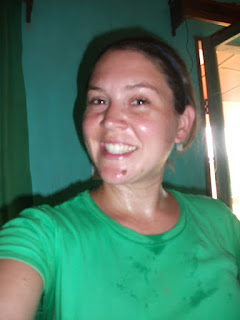 Toodles, everyone.

Saturday, March 10, 2012
Water, water, NOT everywhere
In the past year and a half, Africa has humbled me many times over. Sometimes it’s in a small way, like being gifted with a perfect sunset on my walk home or watching one of the handicapped clients at the social services expertly crank their wheelchair/cart contraptions through potholes, gravel, and sand. Sometimes Africa says to me, “Hey, you lucked out with this Peace Corps thing. Enjoy it while lasts, and keep your eyes open.” And sometimes Africa says to me, “Girl, reality check. You‘re getting too comfortable; allow me to throw you a curveball.”
That happened last week when the well in my yard finally dried out. We’re in the midst of dry season here in Kandi. It has precipitated exactly once since mid-October. Except for that one evening late last month, we’ve had nothing but blazingly blue, cloudless days. This has not done wonders for the easily accessible water supply, obviously. One of the husbands in my compound (there are three other families), mentioned to me that I should start using the pump “around the corner,” because the little water left in the well is pretty dirty (true statement). So last week after buying an old 25 liter plastic container (with its former cooking oil glory extremely hard to remove) I had my eleven year old “petite”/neighbor girl Sonia show me exactly where to find said pump/robinet. “Around the corner” really meant a tenth to a quarter of a mile from our compound. It’s really just a faucet at what appears to just be some enterprising soul‘s home; we waited patiently for the bidon to fill up. Then Sonia asks me to help her pick it up, at which point she gets all 25 liters on her head, and proceeds to carry it home for me. Now, this is a totally normal thing for African girls and women. Their necks become accustomed to heavy loads very early on. I’ve seen women carrying around towers of terra cotta pots four feet tall, piles of wood for cooking fires, and pots and pans full of hot food, often while carrying a baby on their backs or while on the back of a motorcycle. (The latter is an amazing site.)
Sonia and I trudged home with her cousin tagging along. In a trash heap, he found a doll missing her appendages and created an amusing dialogue. “Sonia, ou sont mes jambes? Ou sont mes bras? J‘ai faim.” (Sonia, where are my legs? Where are my arms? I’m hungry!) When we got back to the concession, I assured Sonia this was the one and only time she’d have to do this for me. Once Sonia left me with the bidon, I decided to try carrying it around my house. It’s virtually impossible to lift beyond the level of your knees. Even women here need another person to get whatever they’re carrying positioned on their heads. I propped the bidon halfway on a tabletop and attempted to crouch under it. Even then I knew I was toying with the impossible. Since I enjoy having an intact spinal cord, I decided I’d better try with a half-full bidon instead. I did manage to tote it around for a minute or so, although certainly not comfortably. Naturally I set out for the pump again later that afternoon.
The first thing the woman said when I returned was, “where’s the girl?” I replied that since I really want to learn to do this myself, I left her at home and that I’d eventually figure out how to carry the water on my head, “like an African woman!” “African women suffer,” she said. I decided perhaps I’d just try to carry it instead, as least to start. I also assumed that I could carry the bidon with one or both arms all the way back. I lugged the thing just beyond her yard and out of her sight. Then I dropped the thing and thought I actually might cry because, among other things, my dress was completely soaked through in sweat.
It didn’t take long for a few kids to start snickering, providing ample motivation to get moving. Approximately twenty steps later, I petered out again, and a random pre-teen boy started to take the bidon from me. I thanked him but told him to drop it. I wanted to learn how to do this myself. He was befuddled but eventually left me alone. This exact sequence of events occurred two more times before I made it home fifteen minutes later. I nearly started crying again thinking that I have at least three more months of this ahead of me. As I waited for my arm to regain feeling, I remembered an article in the Peace Corps magazine from a year or so ago. The author of the editorial argued that maybe it’s NOT the best use of a volunteer’s time to do their own laundry and to haul water. Perhaps, he said, that time is better spent on projects. Plus hiring people boosts the local economy, if only a little. I think now, I have to agree with that. But maybe it’s just laziness.
I recounted the story later that night via text message to my friend Nina. Knowing she hauls water from the neighborhood pump in her town, I asked her how she manages it (thinking, however arrogantly, that I’m certainly stronger than she is). “Um, I strap it to my bike?” Of course. Common sense beats brute (or not so brute, as it may be) strength any day.
That happened last week when the well in my yard finally dried out. We’re in the midst of dry season here in Kandi. It has precipitated exactly once since mid-October. Except for that one evening late last month, we’ve had nothing but blazingly blue, cloudless days. This has not done wonders for the easily accessible water supply, obviously. One of the husbands in my compound (there are three other families), mentioned to me that I should start using the pump “around the corner,” because the little water left in the well is pretty dirty (true statement). So last week after buying an old 25 liter plastic container (with its former cooking oil glory extremely hard to remove) I had my eleven year old “petite”/neighbor girl Sonia show me exactly where to find said pump/robinet. “Around the corner” really meant a tenth to a quarter of a mile from our compound. It’s really just a faucet at what appears to just be some enterprising soul‘s home; we waited patiently for the bidon to fill up. Then Sonia asks me to help her pick it up, at which point she gets all 25 liters on her head, and proceeds to carry it home for me. Now, this is a totally normal thing for African girls and women. Their necks become accustomed to heavy loads very early on. I’ve seen women carrying around towers of terra cotta pots four feet tall, piles of wood for cooking fires, and pots and pans full of hot food, often while carrying a baby on their backs or while on the back of a motorcycle. (The latter is an amazing site.)
Sonia and I trudged home with her cousin tagging along. In a trash heap, he found a doll missing her appendages and created an amusing dialogue. “Sonia, ou sont mes jambes? Ou sont mes bras? J‘ai faim.” (Sonia, where are my legs? Where are my arms? I’m hungry!) When we got back to the concession, I assured Sonia this was the one and only time she’d have to do this for me. Once Sonia left me with the bidon, I decided to try carrying it around my house. It’s virtually impossible to lift beyond the level of your knees. Even women here need another person to get whatever they’re carrying positioned on their heads. I propped the bidon halfway on a tabletop and attempted to crouch under it. Even then I knew I was toying with the impossible. Since I enjoy having an intact spinal cord, I decided I’d better try with a half-full bidon instead. I did manage to tote it around for a minute or so, although certainly not comfortably. Naturally I set out for the pump again later that afternoon.
The first thing the woman said when I returned was, “where’s the girl?” I replied that since I really want to learn to do this myself, I left her at home and that I’d eventually figure out how to carry the water on my head, “like an African woman!” “African women suffer,” she said. I decided perhaps I’d just try to carry it instead, as least to start. I also assumed that I could carry the bidon with one or both arms all the way back. I lugged the thing just beyond her yard and out of her sight. Then I dropped the thing and thought I actually might cry because, among other things, my dress was completely soaked through in sweat.
It didn’t take long for a few kids to start snickering, providing ample motivation to get moving. Approximately twenty steps later, I petered out again, and a random pre-teen boy started to take the bidon from me. I thanked him but told him to drop it. I wanted to learn how to do this myself. He was befuddled but eventually left me alone. This exact sequence of events occurred two more times before I made it home fifteen minutes later. I nearly started crying again thinking that I have at least three more months of this ahead of me. As I waited for my arm to regain feeling, I remembered an article in the Peace Corps magazine from a year or so ago. The author of the editorial argued that maybe it’s NOT the best use of a volunteer’s time to do their own laundry and to haul water. Perhaps, he said, that time is better spent on projects. Plus hiring people boosts the local economy, if only a little. I think now, I have to agree with that. But maybe it’s just laziness.
I recounted the story later that night via text message to my friend Nina. Knowing she hauls water from the neighborhood pump in her town, I asked her how she manages it (thinking, however arrogantly, that I’m certainly stronger than she is). “Um, I strap it to my bike?” Of course. Common sense beats brute (or not so brute, as it may be) strength any day.
Subscribe to:
Posts (Atom)